Destination guide

Moving to Malta from New Zealand

A purpose-made permit for remote workers, with a firm income test, and a working holiday visa if you are 18 to 30. Tax programmes for retirees exist, but they are tax statuses with property and minimum-tax conditions.

What we found

The research, in short.

Research information, not advice. Sources last checked 16 October 2026.

Permission that fits your plans

Decide first how you earn and whether you want a work permit, a working holiday or a tax programme. A New Zealand passport lets you visit Malta without a visa, but a stay longer than 90 days needs a residence permit or a long-stay visa.

More detail

The Nomad Residence Permit is the route made for remote work; the Working Holiday Visa is open to New Zealanders aged 18 to 30. More than 43,000 euros a year: Residency Malta Agency requires a minimum gross yearly income. To be safe, have more than 43,000 euros a year, which is about NZ$86,100 at the ECB rate of 15 October 2026. People who applied before 1 April 2024 keep an older, lower figure that does not apply to a new applicant. You must also show a guaranteed source of income at that level for at least 5 months (cumulative) from the day you apply, and your last three months of bank statements must show the income credited directly to your own account. The agency does not publish a separate savings test, and it reviews each file on its merits, so ask Residency Malta whether a family needs more. The figure can change, so confirm it on the agency page when you apply.

Sources: Residency Malta Agency (nomad.residencymalta.gov.mt), European Central Bank. Checked 16 October 2026.

Remote workers and freelancers: Nomad Residence Permit

The permit is for adults aged 18 or over from outside the EU, EEA and Switzerland who work remotely by telecommunications. You qualify as an employee of an employer registered abroad (with a contract of employment), as a partner or shareholder of a foreign company, or as a freelancer or consultant with contracts with clients whose permanent establishments are abroad.

More detail

It is not open to people who serve Maltese companies or individuals, directly or indirectly, or to people contracted by a foreign company who serve its Maltese subsidiary. The agency sets a minimum gross income; to be safe, have more than 43,000 euros a year. The fees are a non-refundable 300 euros per person, paid by bank transfer from the main applicant's own account, and 100 euros per person for the residence card, paid by card at the agency's office. The agency says processing takes about 30 working days after it confirms your payment. The permit lasts one year from the issue of the card and can be renewed three times, up to four years in all, at the agency's discretion. Renewal needs a bank statement showing payments made in Malta to prove at least 5 months of residence in the previous 12. A refused applicant can apply again 12 months after the rejection letter. The permit does not lead to long-term residence or citizenship, holders are not entitled to free health care, pensions or social benefits, and a holder cannot offer services to people or companies based in Malta. Spouses, minor children and some adult dependent children can be included in the first application. The agency's pages state a minimum age of 18 and no upper age limit.

Sources: Residency Malta Agency (nomad.residencymalta.gov.mt). Checked 16 October 2026.

Other routes: the working holiday visa (ages 18 to 30), tax programmes and residence by investment

If you are 18 to 30 you can apply for Malta's Working Holiday Visa, an arrangement between the Governments of Malta and New Zealand that is open to New Zealand citizens. It lasts up to one year (365 days at most).

More detail

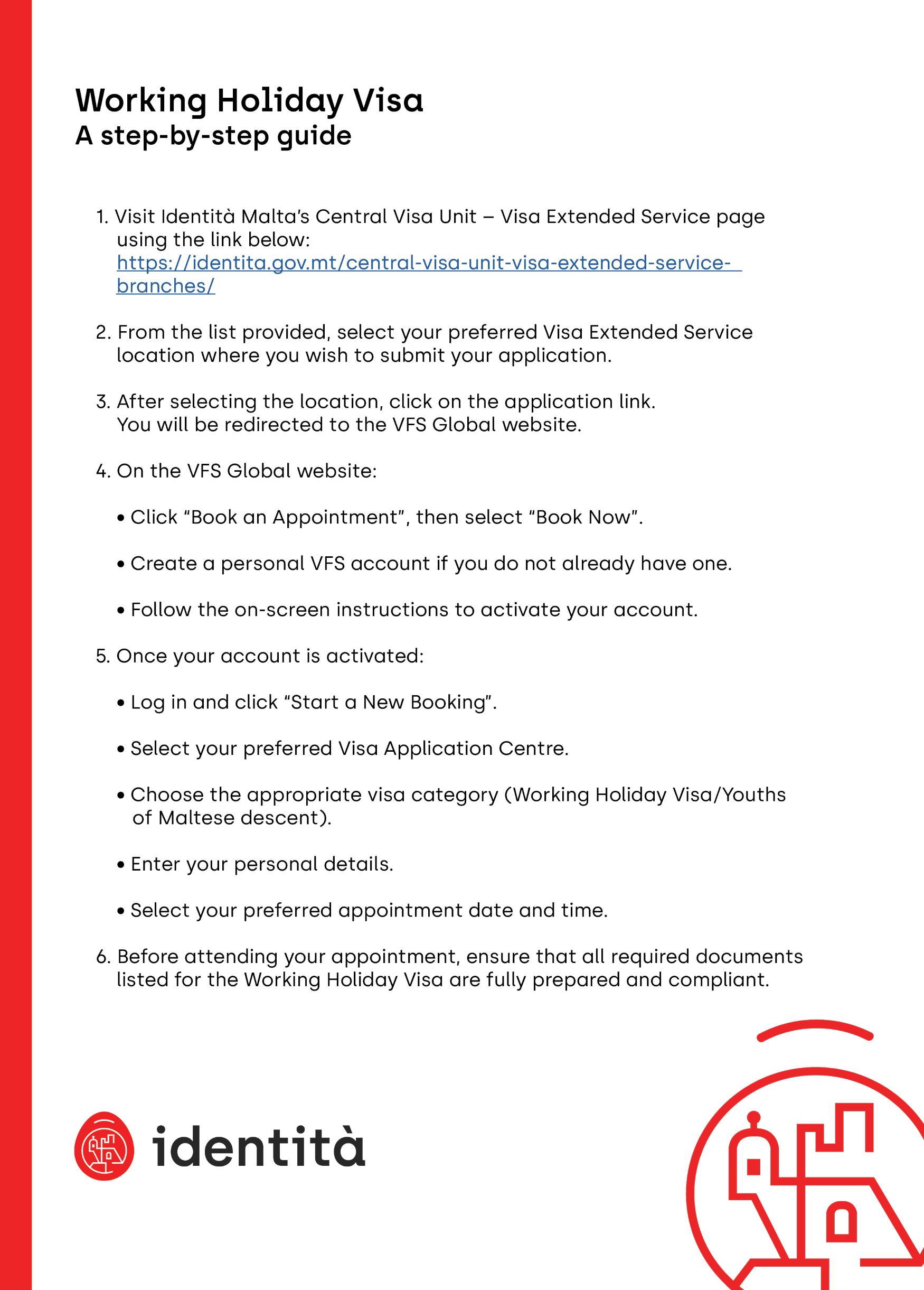
Identita asks for: your age to be 18 to 30 inclusive on the day you apply; a holiday of up to one year as your main purpose; no dependants unless they can enter Malta on their own grounds and apply separately; reasonable funds; medical and comprehensive insurance for the whole stay (the checklist sets at least 100,000 euros of cover, valid in the Schengen area); a valid biometric New Zealand passport valid more than 90 days beyond the expected stay; a return ticket or the funds to buy one; no criminal record (the checklist asks for a police clearance from your state or territory of residence); and no earlier Maltese working holiday visa. In a declaration you state that you hold at least the equivalent of Malta's minimum wage for your first three months, that any work is incidental to the holiday and supplements your holiday funds, and that any registration or licence needed to start work is your responsibility. The 2026 adult minimum wage is 229.44 euros a week, so on our arithmetic three months (13 weeks) comes to a set minimum, though Identita does not print a euro figure for that test (to be safe, hold more than 3,000 euros). The visa fee is waived, but the external provider VFS charges service fees that we could not read. Lodge the application at least 6 weeks before you enter. New Zealand's own list shows Malta at up to 1 year, ages 18 to 30. We found no page saying whether the visa can be renewed or turned into a residence permit, how many are issued a year, which VFS centre serves New Zealand, or whether Malta asks for a work permit or registration after you arrive, so those are unknown. If you are 31 or older on the day you apply, this route is closed to you. Malta's other routes are tax statuses and an investment programme, not work permits. The Malta Retirement Programme is for people whose pension, received in Malta, is at least 75% of their chargeable income; the 2020 guidelines state no age minimum. Under them you need an owned property worth about 220,000 to 275,000 euros, the lower figure applying in Gozo or the south (to be safe, own one worth more than 280,000 euros) or a rented one at about 8,800 to 9,600 euros a year (to be safe, pay more than 9,700 euros a year), you pay 15% on foreign income received in Malta with a minimum tax of 7,500 euros plus 500 euros per dependant, and the application fee is 2,500 euros. The Global Residence Programme under the same guidelines has a 15% rate, a minimum tax of 15,000 euros and a 6,000 euro fee. From 1 January 2027 both are replaced by the Individual Tax Programme (L.N. 195 of 2026): five-year terms that renew, an application fee of 8,500 euros, a qualifying property bought for more than 710,000 euros to be safe or rented for more than 15,000 euros a year to be safe, and a minimum tax of 35,000 euros for a global resident or 15,000 euros a year for a retired pensioner. Statuses granted, or applications received, up to 31 December 2026 keep the earlier terms until 31 December 2031. Holders of these statuses can apply to Identita for a temporary residence permit on the basis of economic self-sufficiency (100 euros); we found no official page saying how long that permit lasts or whether it leads to permanent residence. The Malta Permanent Residence Programme does grant permanent residence: capital assets of more than 510,000 euros to be safe (more than 160,000 euros of it financial) or more than 660,000 euros to be safe (more than 76,000 euros of it financial), a non-refundable administrative fee of 60,000 euros, a Government contribution of 37,000 euros, a property bought for more than 380,000 euros to be safe or rented for more than 15,000 euros a year to be safe for at least five years, a 2,000 euro donation to a local NGO, a fee of 7,500 euros for each adult dependant other than a spouse, and a 500 euro residence card fee per person for five years. It runs only through a licensed agent. These programmes need an adviser.
Sources: Identita, New Zealand Ministry of Foreign Affairs and Trade, Legislation Malta (legislation.mt), Commissioner for Revenue (now Commissioner for Tax and Customs), Residency Malta Agency (residencymalta.gov.mt). Checked 16 October 2026.

Documents and timing

Residency Malta asks you to apply through its online portal with the application form (N4) for each person, a signed letter of intent, a copy of every passport page, a CV, the last three months of bank statements in your own name (downloaded in PDF from your bank, unmasked, with your income credited directly), and an original police conduct certificate less than 6 months old. For employees it also wants the employment contract showing the work can be done remotely; for freelancers the service contracts with the rate of payment; for company owners the certificate of incorporation and share register.

More detail

Spouses add a marriage certificate and children their birth certificates. For a New Zealander the police record comes from the Ministry of Justice, which aims to answer within 20 working days; the agency wants it certified by the national police system of the country of origin and does not say whether it needs an apostille. New Zealand lists Malta as an apostille country (NZ$37 for one certificate and 15 working days, or 5 working days on the urgent service at NZ$120), so ask Residency Malta before you pay for one. After the Letter of Approval in Principle you have 30 working days to submit proof of accommodation and a health insurance policy: a full year pre-paid, covering the European Union (including Malta) and the UK, with a minimum cover of 100,000 euros per person, and travel insurance is not accepted. The accommodation must be a lease of at least 12 months or a purchase in a residential property, not a hostel, boat or caravan, and you submit the Housing Authority registration approval. New Zealanders can visit Malta without a visa for up to 90 days in any 180-day period across the Schengen area, and time in other Schengen states counts. The New Zealand Government says so on its Schengen guidance, and the Atlas Visa Map and the Identita Central Visa Unit page agree. The permit FAQ lists the nationalities that need an entry visa, and New Zealand is not among them, so you apply, wait for approval, and then travel to Malta to give biometrics. Applying does not extend a visa-free stay, so the agency recommends applying 2 to 3 months before your allowed stay ends. After the Letter of Final Approval you tell the agency you have arrived and book biometrics; the card takes 3 to 4 weeks. New Zealand has older bilateral visa waivers with several Schengen states that let New Zealanders stay longer in that one state, but the Commission's April 2019 list of such agreements has no section for Malta and we found no newer list, so we found nothing that adds days in Malta. The EU Entry/Exit System has been fully operational since 10 April 2026 and registers fingerprints and a facial image at the border. ETIAS is scheduled for the last quarter of 2026 but is not yet in operation and the exact start date is not announced; it will cost 20 euros, and the Commission says visa-free nationals will need it. Malta is represented in New Zealand by its High Commission in Canberra, which is also accredited to New Zealand, with an honorary consul in Wellington; New Zealand's Foreign Ministry also says Malta has consular services in Auckland, but lists no Auckland contact. The permit is handled by Residency Malta in Malta, so New Zealanders do not apply through a consulate, and we found no figure printed by the High Commission (its own site refused automated access, so only a November 2025 archive copy was read). The New Zealand Government has no travel advisory for Malta (page updated 25 July 2025) and advises comprehensive medical and travel insurance that covers medical evacuation. Malta's national visa for stays over 90 days is a separate route we did not research for the permit.

Sources: Residency Malta Agency (nomad.residencymalta.gov.mt), New Zealand Government (govt.nz), Ministry of Justice (New Zealand), New Zealand Ministry of Foreign Affairs and Trade, Identita, European Commission, Missions Malta (Ministry for Foreign and European Affairs, Government of Malta), SafeTravel (New Zealand Ministry of Foreign Affairs and Trade). Checked 16 October 2026.

Tax: The nomad permit has its own income tax rule

Malta's Nomad Residence Permits (Income Tax) Rules put a 10% rate on income from authorised work (remote work for a foreign employer or foreign clients). That income is not taxed in the first 12 months from the permit's issue unless you file a declaration with Residency Malta that your residence is not merely casual, and you must still register for income tax.

More detail

If you give official proof that you paid at least 10% tax on the same income abroad, the Maltese tax is treated as settled. Other income stays under the ordinary Income Tax Act. Residency Malta says holding the permit does not by itself entitle you to this treatment and you must meet the rules' conditions; second and third renewals need a tax compliance declaration. How this fits with your New Zealand tax is for an adviser.

Sources: Legislation Malta (legislation.mt), Residency Malta Agency (nomad.residencymalta.gov.mt). Checked 16 October 2026.

Tax: New Zealand keeps its claim while you stay resident

While you remain a New Zealand tax resident, New Zealand taxes your worldwide income, and you file an IR3 and an overseas income summary (IR1261) each year you have income from overseas; you may be able to claim a credit for tax paid overseas. There is no New Zealand-Malta tax treaty, so any relief would come from New Zealand's own rules, and we did not read their conditions.

More detail

Time away does not end residence by itself: a home in New Zealand that you usually live in, even rented out while you are away, can be a permanent place of abode. If you do become a non-resident taxpayer you can still owe New Zealand tax on income from New Zealand sources, and you should tell your bank so the right withholding tax is taken. Malta's own rule for the nomad permit treats Maltese tax as settled if you can prove at least 10% tax was paid on the same income abroad, but we did not find how that works for New Zealand tax. Get a dated opinion before you rely on either.

Sources: Inland Revenue (New Zealand), Legislation Malta (legislation.mt). Checked 16 October 2026.

Setting up: Tax registration and records

Under the nomad tax rules you must register for income tax in Malta, even for work done before the end of the first 12 months. Keep the bank statements the permit needs: three months showing your income credited directly to your own account, and for renewals statements showing payments made in Malta.

More detail

We found no official page saying how long registration takes or what it costs, so that is unknown. Track income and any tax paid in euros and New Zealand dollars so you can show a foreign tax payment and fill in an IR3 and IR1261 while you are still a New Zealand resident.

Sources: Legislation Malta (legislation.mt), Residency Malta Agency (nomad.residencymalta.gov.mt), Inland Revenue (New Zealand). Checked 16 October 2026.

Setting up: Healthcare cover

A permit holder is not entitled to free health care in Malta, and you must buy a policy before the card is issued: premiums for a full year paid in advance, covering the EU including Malta and the UK, at least 100,000 euros of cover per person, meeting the agency's table of minimum benefits. Monthly-payment and travel policies are refused.

More detail

A foreign policy is accepted if it meets those terms. We found no dated price for a policy that qualifies, so that cost is unknown.

Sources: Residency Malta Agency (nomad.residencymalta.gov.mt). Checked 16 October 2026.

Setting up: Banking and your New Zealand accounts

Your income must reach an account in your own name that issues PDF statements, and the agency wants the application fee paid by transfer from the main applicant's own account. We found no official page on which Maltese banks open accounts for non-residents or what they ask for, so that is unknown until you ask a bank.

More detail

If you become a non-resident taxpayer in New Zealand, Inland Revenue says to tell your New Zealand bank so the right withholding tax is taken on interest and dividends.

Sources: Residency Malta Agency (nomad.residencymalta.gov.mt), Inland Revenue (New Zealand). Checked 16 October 2026.

The country

More on Malta.

Sources

Official sources we used.

Government and official pages only, each with the date we checked it.

  1. Global Residence Programme Guidelines, version 2.0 (2020), Internet Archive copy of 13 November 2021, Commissioner for Revenue (now Commissioner for Tax and Customs), Malta. Checked 16 October 2026.
  2. Malta Retirement Programme Guidelines, version 4.0 (2020), Internet Archive copy of 6 August 2024, Commissioner for Revenue (now Commissioner for Tax and Customs), Malta. Checked 16 October 2026.
  3. Euro reference rates, 15 October 2026, European Central Bank. Checked 16 October 2026.
  4. Entry/Exit System, European Commission, Migration and Home Affairs. Checked 16 October 2026.
  5. Main differences between the EES and ETIAS (news item of 28 April 2026), European Commission, Migration and Home Affairs. Checked 16 October 2026.
  6. Schengen visa policy: countries whose nationals do not need a visa, European Commission, Migration and Home Affairs. Checked 16 October 2026.
  7. Smart Borders (ETIAS status), European Commission, Migration and Home Affairs. Checked 16 October 2026.
  8. The European travel authorisation ETIAS will cost EUR 20 (news item of 17 July 2025), European Commission, Migration and Home Affairs. Checked 16 October 2026.
  9. List of Member States' bilateral visa waiver agreements with third countries allowing an extension of the period of stay (OJ C 130, 8 April 2019), European Commission (Official Journal of the European Union). Checked 16 October 2026.
  10. Central Visa Unit (Schengen visa and national visa), as recorded by the Atlas Visa Map, Identita, Central Visa Unit (Government of Malta). Checked 16 October 2026.
  11. Central Visa Unit: Visa Extended Service (VFS application centres), Identita, Central Visa Unit (Government of Malta). Checked 16 October 2026.
  12. Central Visa Unit: Working Holiday Visa (overview), Identita, Central Visa Unit (Government of Malta). Checked 16 October 2026.
  13. Declaration by applicants of Working Holiday Visa (New Zealand, version of 21 March 2025), Identita, Central Visa Unit (Government of Malta). Checked 16 October 2026.
  14. List of requirements: Working Holiday Visa (version 1.0, 16 January 2026), Identita, Central Visa Unit (Government of Malta). Checked 16 October 2026.
  15. Working Holiday Visa: a step-by-step guide (image), Identita, Central Visa Unit (Government of Malta). Checked 16 October 2026.
  16. Working Holiday Visa: New Zealand, Identita, Central Visa Unit (Government of Malta). Checked 16 October 2026.
  17. Non-Employment Permits: Economic Self-Sufficient, Identita (Expatriates Unit, Government of Malta). Checked 16 October 2026.
  18. Leaving New Zealand, Inland Revenue (New Zealand). Checked 16 October 2026.
  19. Overseas income, Inland Revenue (New Zealand). Checked 16 October 2026.
  20. Tax residency status for individuals, Inland Revenue (New Zealand). Checked 16 October 2026.
  21. Tax treaties (New Zealand double tax agreements in force, signed and under negotiation), Inland Revenue (New Zealand), Tax Policy. Checked 16 October 2026.
  22. Individual Tax Programme Rules, 2026 (L.N. 195 of 2026), Government of Malta, Legislation Malta (legislation.mt). Checked 16 October 2026.
  23. National Minimum Wage National Standard Order, 2025 (L.N. 289 of 2025), Government of Malta, Legislation Malta (legislation.mt). Checked 16 October 2026.
  24. Nomad Residence Permits (Income Tax) Rules (S.L. 123.210, L.N. 277 of 2023), Government of Malta, Legislation Malta (legislation.mt). Checked 16 October 2026.
  25. Criminal records: get your own, Ministry of Justice (New Zealand). Checked 16 October 2026.
  26. Malta High Commission in the Commonwealth of Australia, Internet Archive copy of 30 November 2025, Missions Malta (Ministry for Foreign and European Affairs, Government of Malta). Checked 16 October 2026.
  27. Use your NZ documents overseas (apostille and authentication), New Zealand Government (govt.nz), Department of Internal Affairs Authentication Unit. Checked 16 October 2026.
  28. Countries and regions: working holiday visa schemes (New Zealand's arrangements with over 40 countries), New Zealand Ministry of Foreign Affairs and Trade. Checked 16 October 2026.
  29. High Commission for Malta (contact details), New Zealand Ministry of Foreign Affairs and Trade. Checked 16 October 2026.
  30. Information for New Zealanders travelling to Germany, New Zealand Ministry of Foreign Affairs and Trade. Checked 16 October 2026.
  31. Malta (New Zealand relationship, embassies and agreements), New Zealand Ministry of Foreign Affairs and Trade. Checked 16 October 2026.
  32. Nomad Residence Permit: application checklist (version 11, March 2026), Residency Malta Agency (nomad.residencymalta.gov.mt). Checked 16 October 2026.
  33. Nomad Residence Permit: eligibility, Residency Malta Agency (nomad.residencymalta.gov.mt). Checked 16 October 2026.
  34. Nomad Residence Permit: FAQs (version 14.1, updated 17 April 2026), Residency Malta Agency (nomad.residencymalta.gov.mt). Checked 16 October 2026.
  35. Malta Permanent Residence Programme (MPRP), Residency Malta Agency (residencymalta.gov.mt). Checked 16 October 2026.
  36. Malta travel advice (SafeTravel), SafeTravel (New Zealand Ministry of Foreign Affairs and Trade). Checked 16 October 2026.

Your circumstances

See how this applies to you.

A report applies this research to your citizenship, work, money and priorities, and shows what we could not confirm.

Find your best match, Free, about 6 minutes, Free · 6 min. Starts the free interview.