The tax question comes before the visa question
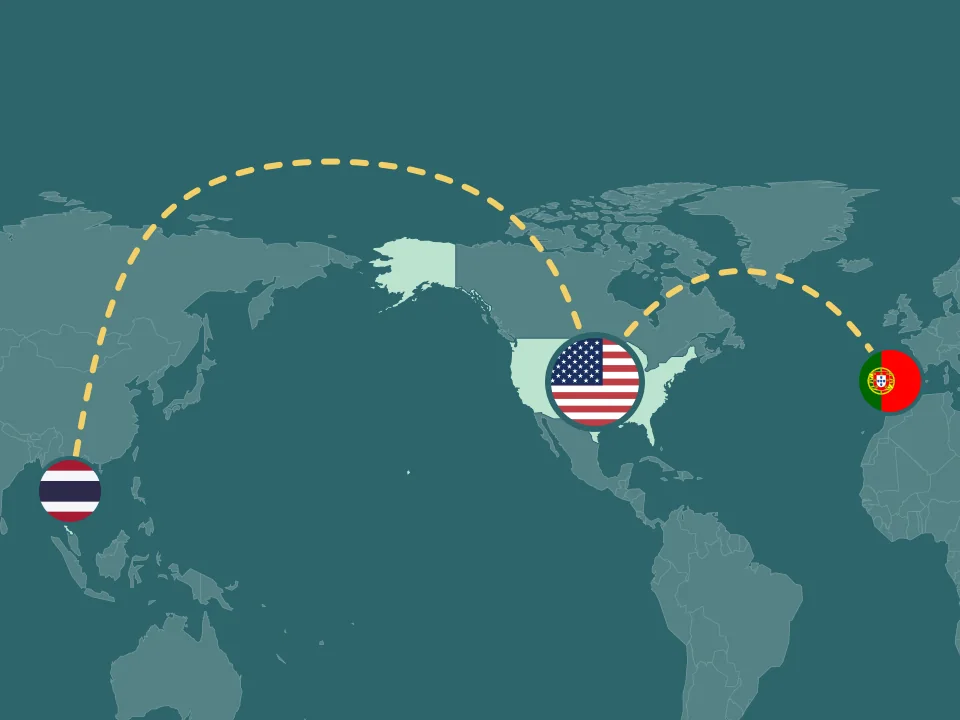
You finish a swing and start looking at a map for where to spend the next fourteen days off, somewhere with a flat you could rent by the month. Before any visa, one question decides how much of your pay you keep: would the Australian Taxation Office (ATO) still treat you as an Australian resident for tax once your base is overseas?
There are four statutory tests: resides, domicile, 183 days and Commonwealth superannuation. Satisfying any one makes you a resident. The resides test is the main one. It asks where you live in the ordinary sense, weighing your physical presence, intention, family and employment ties, assets, and social and living arrangements. No single factor decides it.
A roster pulls both ways. Your job stays in Australia, and so might your accounts and super fund, while your home and routine could move. You are generally still a resident if you go overseas temporarily and set up no permanent home in another country. How the factors balance for a rostered worker is a question for the ATO or a registered tax agent. [T1] [T2]
Domicile and the 183-day count
A doctor flies into Darwin from Auckland, works 10 days, then has 8 to 10 days off at her home in New Zealand. Her usual place of residence is Auckland. The example is the closest to a roster, but it sits on the zone tax offset page and concerns that offset, not tax residency, so it is not a ruling on your case.
Your domicile is the place the law treats as your permanent home, and an Australian who has always lived here keeps it overseas unless they choose to migrate permanently. Under the domicile test you remain a resident unless the ATO is satisfied your permanent place of abode is outside Australia. "Permanent" here means the opposite of temporary, not forever. The factors include the length of your stay overseas, an established home there, a residence kept in Australia, and family and financial ties. With no fixed abode overseas, moving from country to country, you would be a resident under this test.
The 183-day test counts days in Australia in the income year, 1 July to 30 June, continuous or not, including arrival and departure days. More than half the year makes you a resident, unless your usual place of abode is outside Australia and you have no intention of taking up residence here. [T3] [T4] [T5]
What foreign resident status changes on your pay
$18,200 is the tax-free threshold residents get, and a foreign resident for the whole year does not. You also do not pay the Medicare levy, and you claim an exemption for those days. Your Australian pay is taxed at foreign resident rates.
For 2025 to 2026 those rates, in Australian dollars, are 30 cents for each dollar up to $135,000, 37 cents from $135,001 to $190,000, and 45 cents above that. Whether you end up better or worse off than at resident rates depends on your pay, the other country's tax and any offsets, and a registered tax agent can run the figures.
A sale of your Australian home has its own rule: the gain may need to be included in your return if you are a foreign resident when you sign the contract of sale. If you stay a resident, you declare income from both countries and may claim an offset for foreign tax paid. [T1] [T6] [T7]
Super and Medicare: what stays and what does not
Super is the more reassuring half. Generally all employees are eligible for the super guarantee, at 12%, temporary residents such as backpackers included. The exceptions are non-resident employees who work outside Australia, some foreign executives on certain visas, and people temporarily in Australia under a bilateral super agreement. Where you sleep on days off is not on that list, and payroll or the ATO can confirm how your contract is treated.
Medicare is less clear. It does not cover you overseas, and you may need to enrol again on return, depending on how long you were away, with different rules for permanent residents and citizens. How long you can be away before enrolment lapses: not published; ask Services Australia.
Australia has reciprocal healthcare agreements with eleven countries, and Thailand, Malaysia and Portugal are not among them, so time spent there needs its own insurance. An insurer can quote for your dates. [M1] [H1] [H2]
How the days add up in each place
Two weeks on and two off adds up to about 182 days a year if every day off is spent in one place. Eight on and six off gives about 156. Two weeks on and one off gives about 122, and four on and one off about 73. That is our arithmetic, before travel days, and it shows how a roster with long breaks can sit near the Thai, Malaysian, Portuguese and Australian lines at once.
Each country counts days its own way. Thailand treats you as resident at 180 days or more in the tax year (its English summary says more than 180, so count carefully) and taxes residents on foreign income earned from 1 January 2024 and brought into Thailand. Malaysia's line is 182 days or more in the year, with linked-period and 90-day rules that can apply on fewer days. Portugal makes you resident after more than 183 days in any 12-month period beginning or ending in the tax year, or on fewer days if you have a home available in conditions suggesting you intend to keep it as your habitual residence.
When two countries both call you resident, a treaty tie-breaker would usually decide which can tax. Treasury's list, updated 24 March 2026, shows treaties in force with Thailand and Malaysia. Portugal is not on it: a treaty was signed on 30 November 2023 but is not shown as in force. [T1] [T8] [T9] [T10] [T11] [T12] [T13]
Short stays between swings
Since 15 September 2026 Thailand has exempted Australian passport holders from a visa for tourism for up to 30 days, replacing the 60-day exemption. An officer may extend it by up to 30 days at their discretion, and visitors must show cash of THB 20,000. Land-border entries are generally limited to two a year. Limits on air arrivals, and whether officers question frequent entries: not published; ask the embassy.
Australians can usually get a 90-day tourism visa on arrival in Malaysia, but business, volunteer work, study and research need a visa arranged beforehand.
In Portugal and the rest of the Schengen area you can stay up to 90 days in any 180, counting back from each day, and Australia is among the nationalities exempt from a short-stay visa. On a two-and-two roster spent wholly in Portugal, a 180-day window holds about 90 days: the whole allowance, nothing spare. On the 8 and 6 roster it is about 77.
The Thailand guide, the Malaysia guide and Malaysia against Thailand cover the rest. [V1] [V2] [V5] [V9] [V10]
Longer permissions and what they assume about your work
The longer routes were written with other workers in mind. Thailand's Destination Thailand Visa has a "workcation" purpose for digital nomads, remote workers, foreign talent and freelancers. The Washington embassy asks for a balance of at least THB 500,000 at the end of each of the last three months (to be safe, more than THB 510,000) and an employment contract, certificate or portfolio. The Helsinki embassy lists up to 180 days a stay and one 180-day extension. Fees differ by embassy (US$400 in Washington, 350 euros in Helsinki), and the embassy in Canberra can confirm the fee and documents for an Australian applicant. A rostered on-site job is not among the categories named.
Malaysia's DE Rantau pass is for employees of a company not registered in Malaysia who work remotely outside any physical office setting. The income test is US$24,000 a year for tech roles (to be safe, more than US$25,000) and US$60,000 for others (more than US$61,000). It runs 3 to 12 months, renewable once. MM2H Silver asks for a US$150,000 fixed deposit (to be safe, more than US$160,000), a home worth RM600,000 or more, and 90 days in Malaysia each year, and it bars business or investment activities. Whether a job in Australia counts under either: not published; ask the issuing body.
Portugal's remote-work route asks for a work contract or employer declaration and, over the last three months, average monthly income of at least four times the guaranteed minimum. That minimum is 920 euros from 1 January 2026, so the test is 3,680 euros (to be safe, more than 3,700). The passive-income route is built around revenue from property or assets, not wages. Neither mentions rostered work. See the Portugal guide and Portugal against Thailand. [V3] [V4] [V6] [V7] [V8] [M2]
What to settle before you sign a lease
Little is published for rostered workers, so the useful work is gathering facts. Start a day log today, with days in Australia, days abroad and travel days. Run the ATO's residency tool with your real ties (home, family, accounts, super, mail) and note where the answer is unclear. Put the question to the embassy of your destination, whether a rostered job fits the visa, and keep the reply. A registered tax agent in Australia, and one in the destination, can say how a treaty or its absence applies to you, and an insurer can price cover for the time abroad. [T1]
Fernshore articles explain published rules as of the dates shown in the sources. They are research, not legal, tax or financial advice for your situation.
Sources
- [T1] Australian resident for tax purposes, Australian Taxation Office. Checked 17 October 2026.
- [T2] Residency: the resides test, Australian Taxation Office. Checked 17 October 2026.
- [T3] Residency: the domicile test, Australian Taxation Office. Checked 17 October 2026.
- [T4] Residency: the 183-day test, Australian Taxation Office. Checked 17 October 2026.
- [T5] Zone tax offset (eligibility and example of a rotational worker), Australian Taxation Office. Checked 17 October 2026.
- [T6] Foreign and temporary residents, Australian Taxation Office. Checked 17 October 2026.
- [T7] Tax rates: foreign resident, Australian Taxation Office. Checked 17 October 2026.
- [M1] Work out if you have to pay super, Australian Taxation Office. Checked 17 October 2026.
- [H1] Before you leave Australia (Medicare and going overseas), Services Australia. Checked 17 October 2026.
- [H2] Reciprocal healthcare agreements (updated 23 July 2026), Victorian Department of Health. Checked 17 October 2026.
- [T8] Guide to Personal Income Tax Return 2024 (P.N.D. 90), The Revenue Department (Thailand). Checked 17 October 2026.
- [T9] Personal income tax: taxable person, The Revenue Department (Thailand). Checked 17 October 2026.
- [T10] Residence status (section 7, Income Tax Act 1967), Inland Revenue Board of Malaysia (LHDN / HASiL). Checked 17 October 2026.
- [T11] Article 16, residence (Personal Income Tax Code), Portuguese Tax and Customs Authority. Checked 17 October 2026.
- [T12] Income tax treaties (list updated 24 March 2026), Australian Treasury. Checked 17 October 2026.
- [T13] Portugal tax treaty, Australian Treasury. Checked 17 October 2026.
- [V1] New Tourist Visa Exemption Scheme (30 days), effective 15 September 2026, Royal Thai Embassy, Washington D.C.. Checked 17 October 2026.
- [V2] Thailand introduces new 30-day and 15-day visa exemption rules from 15 September, Tourism Authority of Thailand (TAT Newsroom). Checked 17 October 2026.
- [V3] Destination Thailand Visa (DTV): requirements, Royal Thai Embassy, Washington D.C.. Checked 17 October 2026.
- [V4] Destination Thailand Visa (DTV): period of stay and extension, Royal Thai Embassy, Helsinki. Checked 17 October 2026.
- [V5] Malaysia travel advice, Smartraveller (Australian Government, DFAT). Checked 17 October 2026.
- [V6] DE Rantau Pass FAQ, version 10.0 (28 August 2026), Malaysia Digital Economy Corporation (MDEC). Checked 17 October 2026.
- [V7] MM2H Silver category, Ministry of Tourism, Arts and Culture (MOTAC), MM2H portal. Checked 17 October 2026.
- [V8] Residency visa: necessary documentation, Portuguese Ministry of Foreign Affairs (visa portal). Checked 17 October 2026.
- [V9] Short-stay calculator (90/180-day rule), European Commission, Migration and Home Affairs. Checked 17 October 2026.
- [V10] Short-stay visas: who needs a visa, Portuguese Ministry of Foreign Affairs (visa portal). Checked 17 October 2026.
- [M2] Guaranteed monthly minimum remuneration for 2026, Directorate-General for Employment and Labour Relations (DGERT). Checked 17 October 2026.
See what your situation makes possible.