Two problems an agreement is built to fix
Ten years of work at home and six abroad can leave you with a full pension from neither country. Meanwhile one salary can be charged by two countries' pension schemes at once. Both turn up early: when an offer arrives with a start date in Lisbon, or when you plan to freelance from Mexico and have to ask which scheme takes the contributions.
Bilateral social security agreements, often called totalization agreements, exist for those two problems. The US Social Security Administration (SSA) gives them two main purposes: to remove dual social security taxation, and to fill gaps in benefit protection for people who split a career between two countries.
An agreement does not make a pension larger, since Canada says it only helps determine eligibility. Nor does it let you pick the cheaper system, an idea the SSA calls a misconception. [M1] [M6]
How an agreement stops double contributions
Without an agreement, one salary can be charged twice, because US coverage follows citizens and residents who work abroad for American employers, and self-employed Americans abroad, while most countries charge anyone working in their territory.
Agreements start from a territory rule: an employee who would be covered by both systems stays under the law of the country where they work. The main exception is the detached-worker rule. A person sent temporarily by an employer to work for the same employer in another country stays covered only by the sending country, and only that country's contributions are paid. In US agreements this generally applies to assignments expected to last 5 years or less. The agreement with Italy has no detached-worker rule and looks mainly at nationality.
The time limit differs by agreement. Canada's maximum initial detachment period is 24 months for Italy and Portugal, 36 months for France, and 60 months for Mexico, Spain and the United States. The Australian Taxation Office gives the longest certificate period for Australian employers as 4 years for Portugal and 5 years for the United States.
Exemption has a cost. Workers exempted from Portuguese coverage pay into none of its sickness, injury or unemployment programmes and generally cannot draw from them, so other cover may be needed. [M1] [M3] [M7] [M10]
Certificates of coverage, and the self-employed
An American sent to the United Kingdom needs a certificate from the SSA to show the UK that no UK contributions are due. That certificate of coverage, issued by the country that will keep covering you, is the proof of exemption. Employers generally request them for transferred staff, and self-employed people request their own.
Canada asks employers to request one as soon as they know a worker will be temporarily outside Canada, on a form numbered for each country (CPT56 for the United States). The ATO generally assesses an application within 28 days and says to apply before the employee leaves.
Self-employment follows different rules. US coverage extends to self-employed citizens and residents wherever they work, so they are often covered twice. Some agreements assign coverage to the country of residence, and others let a self-employed person move their activity between countries for a temporary period. Under the US agreements with Canada and Portugal, self-employed people are assigned the coverage of the country where they live. A self-employed American exempted from US self-employment tax by a foreign certificate attaches a copy to the US tax return each year.
Australia's certificate route is narrower. An employee is eligible only if they accept an Australian employer's offer to work temporarily overseas, not if they take a new job abroad or are self-employed. [M1] [M2] [M3] [M8] [M10]
Adding years together so a short career still counts
Someone who reaches 62 in 1991 or later generally needs 40 quarters of coverage, the SSA's work credits, for a US retirement benefit. An agreement helps when you have some US coverage but not enough. The SSA counts the coverage you earned in the agreement country, and the other country counts your US coverage in the same way. This works only if you have at least six quarters of US coverage, and the other country may set a minimum of its own.
If the combined record is enough, each country pays a partial benefit. The US amount reflects the share of your career completed in the US, and Canada likewise pays on its own creditable periods. If you cannot qualify for a CPP benefit on your contributions alone, Canada treats your US contribution periods as CPP contribution periods. CPP and OAS payments are covered in leaving Canada for tax purposes.
Australia works through residence. Periods of residence in Australia can be combined with periods of contributions in the agreement country, and you usually get a part pension from each agreement country you live in. For New Zealand, time in an agreement country can count towards the residence years needed for NZ Super, but only from one agreement country at a time. A US 401(k) or IRA is a separate question; see taking a US 401(k) or IRA abroad. [M1] [M6] [M9] [M11] [M12] [M13]
Who has an agreement with whom
A New Zealand passport holder working in Lisbon has no agreement to lean on, while a Canadian in the same job does. The lists below are as of 17 October 2026 and cover the eight destinations Fernshore has guides for. "Not listed" means the destination is not on that government's list of agreements in force, not that no pension is payable.
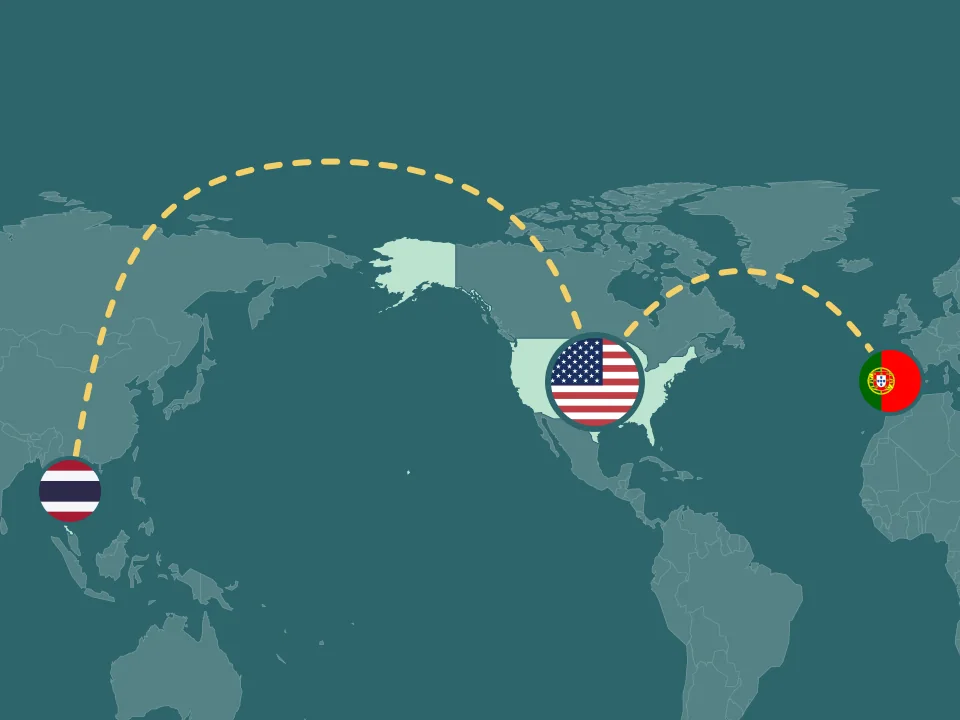
- United States passport: listed for Portugal, Spain, France and Italy. Not listed for Mexico, Costa Rica, Thailand or Malaysia.
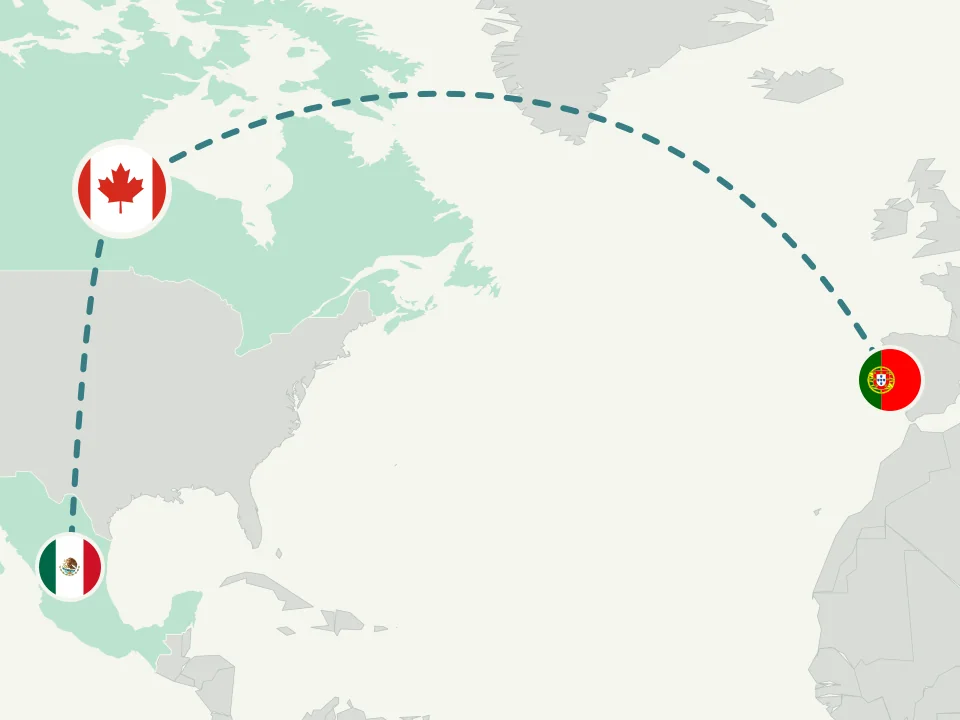
- Canadian passport: listed for Portugal, Spain, Mexico, France and Italy. Not listed for Costa Rica, Thailand or Malaysia.
- Australian passport: listed for Portugal, Spain and Italy. Not listed for France, Mexico, Costa Rica, Thailand or Malaysia. For the coverage and super side, the ATO's list of agreements includes Portugal but not Spain or Italy.
- New Zealand passport: not listed for any of the eight. New Zealand's agreements are with Australia, Canada, Denmark, Ireland, Jersey, Guernsey, Greece, Malta, the Netherlands, South Korea and the United Kingdom.
Among the four passport countries, the United States has agreements with Canada and Australia, Canada with Australia and New Zealand, and Australia with New Zealand. None is listed between the United States and New Zealand. Canada's agreements with Australia and New Zealand do not coordinate coverage, so no certificate exists there.
A listed agreement does not mean the same rules everywhere, as the time limits above show. For local rules, read the Portugal guide, the Spain guide or the Portugal and Spain comparison. [M1] [M6] [M7] [M9] [M10] [M11]
When there is no agreement
Costa Rica, Thailand and Malaysia appear on none of the four passport lists above. If your passport country has no agreement with the place you work, there is no certificate to ask for and no rule that stops both countries claiming contributions. Dually taxed workers usually get no added protection for the foreign contributions, which may be lost on a short stay. Whether a country charges foreign workers, and from when, is set by its own law. Not covered here; ask its social security body.
On the benefit side, each country judges your record alone, so a US benefit rests on your US credits only. Canada says an agreement is not required to apply, and you may still qualify for Canadian or foreign pensions on your contributions or residence in each country.
A retiree who never works in the new country may never meet the coverage rules. The Mexico guide covers residence and visa rules for a country where only Canada is listed. [M1] [M6]
The 2025 repeal of the windfall and pension offset rules
For Americans, one change is separate from agreements but affects people who worked in jobs outside Social Security. The Social Security Fairness Act of 2023, approved on 5 January 2025 as Public Law 118-273, repealed the Government Pension Offset and the Windfall Elimination Provision for benefits payable for months after December 2023.
Benefits are no longer reduced because of pensions from jobs that did not pay into Social Security. Anyone already reduced will have the amount added back, with repayment of what was withheld since January 2024. Foreign pensions are not worked through case by case, so if you receive a pension from work abroad, ask the SSA how your record is treated today. [M4] [M5]
What decides whether an agreement helps you
How you go abroad matters most, because an employee sent by an employer, one hired locally and a self-employed person are each treated differently. Next come the maximum detachment or certificate period for the agreement, set against how long you expect to stay, and whether your home record meets the minimum needed to add foreign years, such as the SSA's six US quarters. Settle early who will request the certificate, and by when. [M1] [M6]
Fernshore articles explain published rules as of the dates shown in the sources. They are research, not legal, tax or financial advice for your situation.
Sources
- [M1] U.S. international social security agreements overview, Social Security Administration. Checked 17 October 2026.
- [M2] Totalization agreement with Canada, Social Security Administration. Checked 17 October 2026.
- [M3] Totalization agreement with Portugal, Social Security Administration. Checked 17 October 2026.
- [M4] Pensions and work abroad won't reduce benefits, Social Security Administration. Checked 17 October 2026.
- [M5] Public Law 118-273, Social Security Fairness Act of 2023, U.S. Government Publishing Office. Checked 17 October 2026.
- [M6] Social security agreements, Government of Canada, Service Canada. Checked 17 October 2026.
- [M7] What is the purpose of international social security agreements?, Canada Revenue Agency. Checked 17 October 2026.
- [M8] How to apply for a certificate of coverage, Canada Revenue Agency. Checked 17 October 2026.
- [M9] International social security agreements, Department of Social Services (Australia). Checked 17 October 2026.
- [M10] Bilateral social security agreements (super certificate of coverage), Australian Taxation Office. Checked 17 October 2026.
- [M11] Social Security Agreements and special arrangements with other countries, Work and Income (Ministry of Social Development, New Zealand). Checked 17 October 2026.
- [M12] International social security agreements, Services Australia. Checked 17 October 2026.
- [M13] Pensions and benefits: United States, Government of Canada, Service Canada. Checked 17 October 2026.
See what your situation makes possible.